Rubber-Band Vehicle Mechanics
A precision vehicle is a connected mechanical system. One weak or inconsistent part can change the complete result.
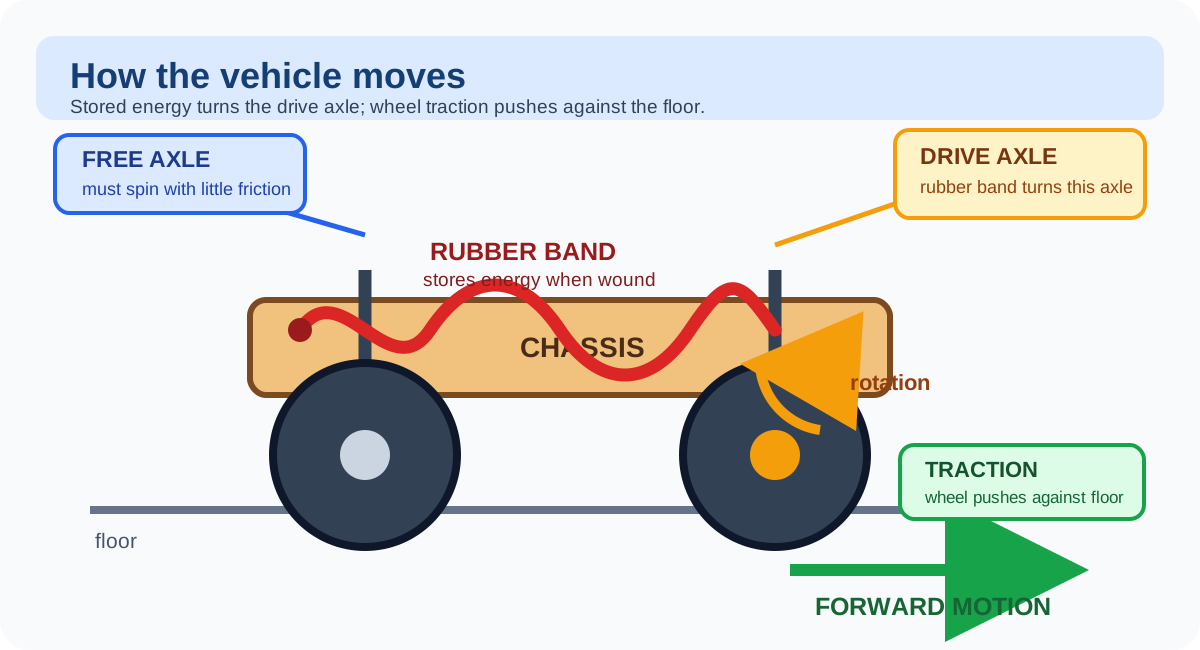
The complete system
Stored energy, axle rotation, wheel traction, alignment, and chassis rigidity work together. Improving one part cannot compensate for every problem elsewhere.
Propulsion
Winding a rubber band stores energy. When released, the band unwinds and turns the drive axle. The axle turns the drive wheels, and friction between the wheels and floor pushes the vehicle forward.
More winding does not always produce better precision. Too much force may make wheels slip, twist the chassis, or increase inconsistency.
Wheels and axles
- Round, centred wheels rotate more smoothly.
- Wheels on the same axle should be similar in diameter.
- Axles should be straight and parallel.
- Wheels need clearance so they do not rub the chassis.
- Axle supports should hold alignment without squeezing the axle.
Friction and traction
Some friction is useful: wheels need traction against the floor. Friction inside an axle support or between a wheel and chassis wastes energy.
The goal is not “remove all friction.” The goal is useful traction with minimal unwanted rubbing.
Chassis and stability
The chassis holds the propulsion, axle, and wheel systems in alignment. It should be rigid enough to resist twisting but not heavier or larger than necessary. Wheelbase, track width, mass distribution, and connection quality affect straight travel and stability.
Accuracy and consistency
- Accuracy describes how close the stopping position is to the target.
- Consistency describes how similar repeated trials are.
A vehicle can be accurate once but inconsistent overall. A useful design process aims for both.
Precision is repeatable
One excellent trial is not enough. A strong design produces controlled results across repeated trials.
Technical vocabulary
Chassis, drive axle, free axle, axle support, wheel diameter, wheelbase, track width, propulsion, stored energy, friction, traction, alignment, stability, accuracy, consistency, prototype, iteration
AI can help you understand mechanics
Use the AI support guide to ask for an explanation, analogy, diagram description, or diagnostic questions. AI should help you understand the system; it should not design the vehicle or write your reflection.
Quick understanding check
- Where is energy stored before the vehicle is released?
- What transfers that energy to the wheels?
- Which friction is useful, and which friction is harmful?
- Why might a vehicle curve even when both wheels appear to turn?
- What is the difference between accuracy and consistency?